Top lane wave management: freeze, slow push and crash
Jump to section
- The basic idea of top lane wave management
- The three wave states at a glance
- Freeze: deny the enemy
- Slow push: stack a big wave
- Crash: push it into the tower
- The bounce
- Back timings and the wave
- Wave management before objectives
- How to break a freeze against you
- Common wave management mistakes
- Questions players ask
- Sources
Top lane wave management means controlling where the minion wave sits by changing how fast you kill minions. The wave decides who is safe, who can trade and who gets ganked. So once you control it, you control the lane.
The minion wave is the most important resource in top lane. Freeze it, slow push it or crash it, and each choice sets up a different play. This guide covers all three, the bounce that links them, and how to break a freeze when the enemy uses one against you.
The basic idea of top lane wave management
Each wave has three melee minions and three caster minions. A siege minion, also called a cannon, joins some waves. According to the League of Legends Wiki, the first wave spawns at 0:30 and a new wave follows every 30 seconds. From 14:00 waves come every 25 seconds, and from 30:00 every 20 seconds.
Waves meet in the middle of the lane at the start of the game. When one side kills minions faster, its wave pushes towards the other side's tower. So every decision in top lane wave management comes down to one question: do you kill minions faster, slower or only when they are about to die?
Cannon waves matter too. The first cannon arrives with the third wave at 1:30, then one comes every third wave until 14:00. Because a cannon wave is bigger, it pushes harder and is worth more gold.
The three wave states at a glance
Top lane wave management uses three basic states. Learn what each one is for before you learn the details.
- Freeze: you last-hit only, so the wave stays near your tower. Use it to deny the enemy and to farm safely.
- Slow push: you kill the enemy casters first, so your wave grows over two or three waves. Use it to set up a dive, a recall or a roam.
- Crash: you kill the whole wave fast, so it hits their tower. Use it before you recall, before an objective or before you Teleport.
Freeze: deny the enemy
A freeze keeps the wave near your own tower without letting it reach the tower. You only last-hit, so the wave stays in place.
Now the enemy has to walk far up the lane to farm. That puts them in range of your jungler, and it also costs them gold and experience if they refuse. Freeze when you are ahead and want to keep the enemy off resources. It also works when you are behind and need to farm safely.
A freeze works best when the enemy wave is a few minions bigger than yours. If your wave is bigger, it pushes forward and the freeze breaks. A deeper guide on how to freeze a wave, with exact positions, is coming soon.
Slow push: stack a big wave
To slow push, kill the enemy caster minions first and leave their melee minions alone. Then your wave grows over the next two or three waves and hits the enemy tower as one large stack.
Use a slow push before a dive with your jungler. It also works before a recall, because the enemy loses minions under their tower while you shop. And it sets up a roam, since the enemy has to stay and catch the stack.
Always know what you will do when the stack crashes. A slow push with no plan behind it gives the enemy a free wave to farm.
Crash: push it into the tower
To crash, kill the whole wave as fast as you can so it reaches the enemy tower. Then the enemy has to stay and catch the wave or lose minions under their tower.
Crash before you recall, before an objective fight or when you want to use Teleport. A crash buys you time. If you then spend that time on the map, you gain more than the enemy who stays to farm.
The bounce
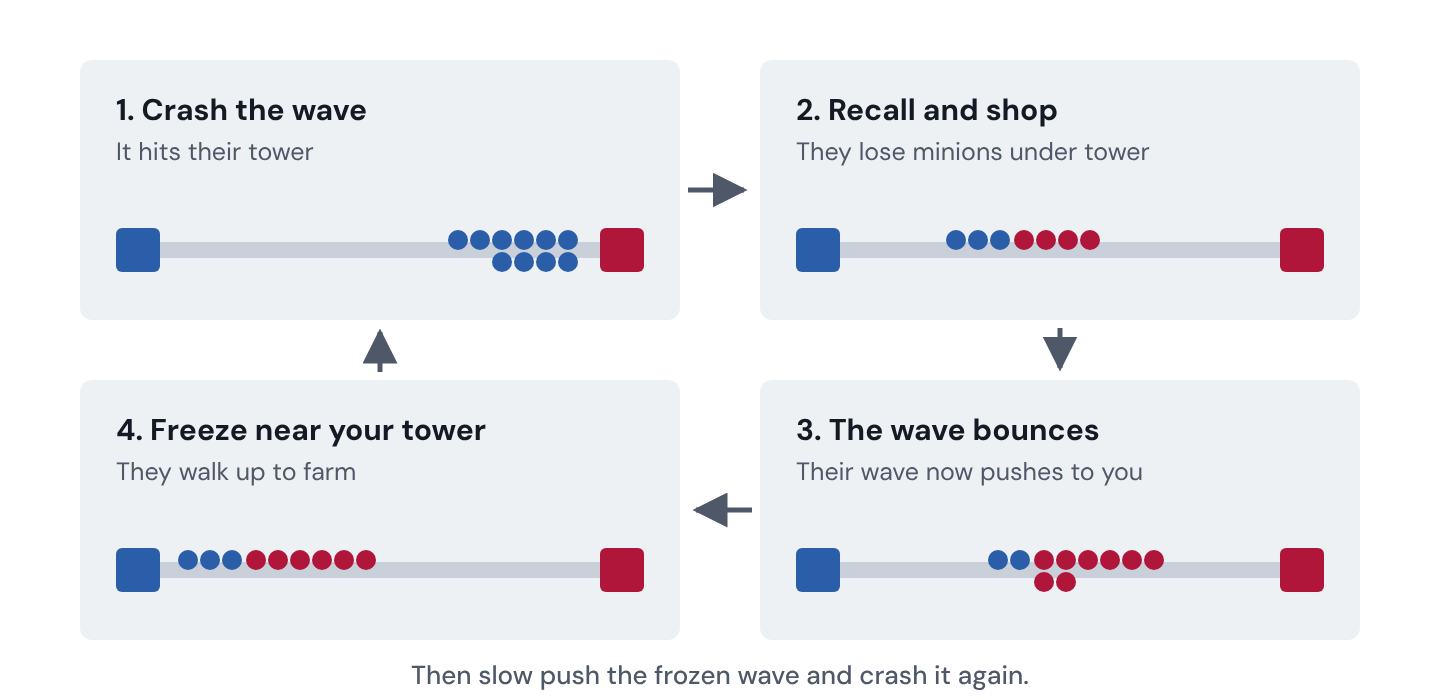
After a wave crashes into a tower, the next wave usually pushes back towards your side. This is the bounce.
Plan around it. First crash the wave, then recall and shop. By the time you return, the wave is coming to you, which sets up a freeze near your tower. That loop of crash, recall, bounce and freeze is the core of top lane wave management.
Back timings and the wave
Recall timing is the part of top lane wave management most players ignore. Many top laners lose gold through bad recalls. If you recall with your wave pushing towards you, the enemy shoves it into your tower and you lose minions there.
So crash before you recall whenever you can. If you cannot crash, recall right after the enemy wave dies, before the next one arrives. Then you return to a wave that is still in a good place.
Also watch the cannon wave. Losing a cannon minion under your tower costs more than a normal wave, so try to be in lane for it.
Wave management before objectives
Good top lane wave management also helps your whole team. Before an objective spawns, push your wave first. Then the enemy top laner has to choose between catching the wave and joining the fight.
If you join the fight while your wave pushes, you lose nothing. If the enemy follows you, they lose minions and maybe a tower. This is the same idea that makes split pushing work, covered in our guide on how to split push.
How to break a freeze against you
When the enemy freezes near their tower and you cannot farm safely, you have three options.
- Fight the enemy laner near the wave, so your minions win the fight for you.
- Ask your jungler to come and push the wave with you.
- Accept the lost minions and recall to buy items.
Walking up alone to last-hit while the enemy jungler is missing is how many top lane games are lost. If you do not know where the jungler is, pick option two or three.
Common wave management mistakes
- Pushing for no reason. Every push should set something up. If it does not, last-hit and let the wave come to you.
- Recalling with the wave on your side. You lose minions under your tower and come back behind.
- Freezing with a bigger wave. Your minions push forward and the freeze breaks.
- Ignoring the enemy jungler. A frozen wave only protects you if you also track the jungler.
Good wave control also makes trading easier. Read our guide on how to trade in top lane next, then the full top lane climbing guide.
Questions players ask
What is top lane wave management?
Top lane wave management is controlling where the minion wave sits by changing how fast you kill minions. The three main tools are the freeze, the slow push and the crash. Each one sets up a different play, from denying the enemy farm to diving with your jungler.
How many minions do you need to freeze?
The enemy wave needs to be a few minions bigger than yours, so it keeps pushing into you while you only last-hit. If your wave is bigger, the freeze breaks and the wave pushes towards the enemy.
How do I break a freeze in top lane?
Kill enough enemy minions to push the wave back, often by fighting the enemy laner near the wave, or ask your jungler for help. If neither works, give up the wave, recall and buy items so you come back stronger.
When should I crash the wave?
Crash the wave before you recall, before an objective spawns or before you use Teleport. A crashed wave keeps the enemy busy at their tower, which buys you time to act elsewhere on the map.
 X



Sources
- Minion (League of Legends) (League of Legends Wiki)
- Wave management: when to freeze, slow push and fast push (LoL Theory)
- Wave management explained: freezing, slow pushing and crashing (Nerfplz)
Checked on 20 November 2026, reviewed for patch 26.23. Abilities and numbers can change with patches. How guides are written